📡 Massive MIMO Technology
A Complete Guide to Multi-Antenna Systems & Advanced Beamforming
Massive Multiple-Input Multiple-Output (Massive MIMO) is a revolutionary wireless technology that uses large antenna arrays to dramatically increase network capacity, spectral efficiency, and energy efficiency. Discover how technologies such as 32T32R, 64T64R, and larger antenna arrays power next-generation 5G networks.
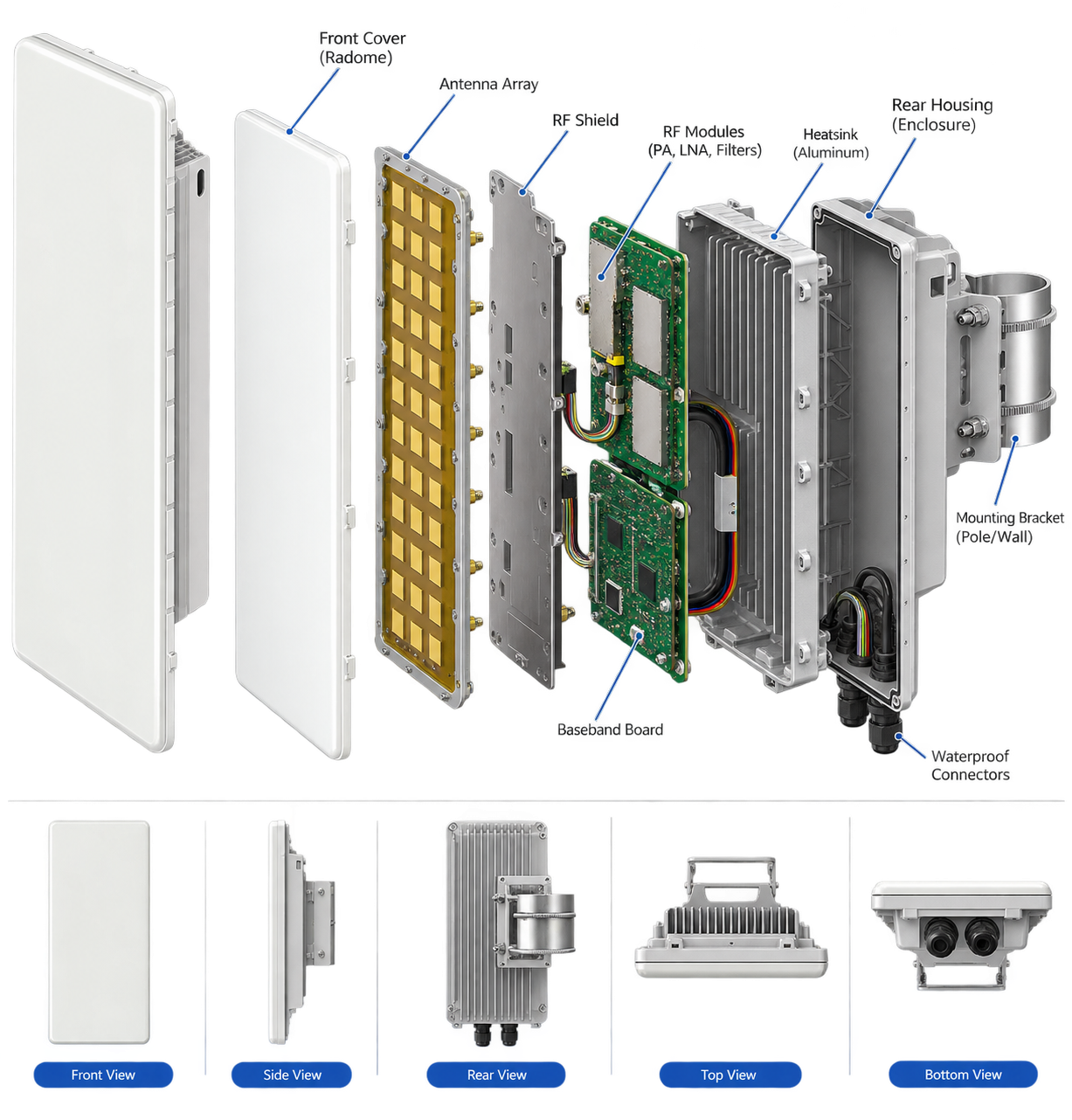
What is Massive MIMO?
Massive MIMO technology enables base stations to communicate with many users simultaneously using large arrays of antennas. The key principle is exploiting spatial degrees of freedom to serve multiple terminals in the same frequency band.
- Large antenna arrays at the base station
- Simultaneous multi-user transmission
- Spatial multiplexing and beamforming
- Improved channel separation
- Interference suppression capabilities
Configuration Sizes
Massive MIMO deployments vary from moderate to very large antenna arrays. Each configuration offers different trade-offs between performance, cost, power consumption, and physical size.
- 32T32R: 32 transmit and 32 receive paths
- 64T64R: 64 transmit and 64 receive paths
- 128T128R: 128 transmit and 128 receive paths
- 256T256R: 256 transmit and 256 receive paths
- Beyond 5G: Larger distributed and intelligent antenna systems
Key Performance Gains
Massive MIMO can deliver substantial improvements across important network metrics, enabling higher capacity and better user experience.
- Higher spectral efficiency through spatial multiplexing
- Improved energy efficiency through focused transmission
- Better coverage through beamforming
- Reduced interference between users and cells
- Improved channel utilization with advanced precoding
🎯 How Massive MIMO Works: The Core Principles
Massive MIMO operates on advanced signal-processing principles that exploit the characteristics of wireless propagation and multiple antenna elements.
1️⃣ Channel Orthogonality
When a base station has many more antennas than active users, user channels can become increasingly distinguishable. This allows the base station to separate users and reduce mutual interference through advanced precoding techniques.
2️⃣ Beamforming & Beam Management
Transmit Beamforming:
The base station calculates antenna weights to direct radio
energy toward intended users while reducing unwanted radiation
toward other directions.
Receive Beamforming:
Signals received by multiple antenna elements are combined
intelligently to improve the desired signal and suppress
interference.
3️⃣ Pilot-Based Channel Estimation
Users transmit pilot signals, also called reference signals, that allow the base station to estimate the wireless channel. In TDD systems, channel reciprocity can significantly reduce downlink channel-estimation overhead compared with FDD systems.
4️⃣ Multi-User Detection & Interference Suppression
With accurate channel information, the base station can calculate precoding and combining vectors that allow simultaneous transmission to multiple users on the same time-frequency resources while controlling interference.
🚀 Advanced Techniques in Massive MIMO
Zero Forcing (ZF) & Regularized Zero Forcing (RZF)
Zero Forcing precoding attempts to reduce inter-user interference by using the estimated channel matrix to calculate suitable precoding weights. Regularized Zero Forcing adds regularization to improve robustness, particularly under noise and imperfect channel conditions.
Maximum Ratio Transmission (MRT)
Maximum Ratio Transmission, also called conjugate beamforming, aligns transmission with the estimated channel of each user. It is computationally simpler than some interference-nulling techniques and can perform well when interference is manageable.
Antenna Array Geometries
Hybrid Precoding (Analog + Digital)
Practical systems can combine analog beamforming with digital precoding. This can reduce the number of required RF chains and power consumption while maintaining many of the benefits of advanced multi-antenna transmission.
📈 Performance Comparison: Conventional vs Massive MIMO
| Metric | 4G Conventional MIMO | 5G Massive MIMO | Advanced Systems |
|---|---|---|---|
| Antenna Configuration | 2T2R – 8T8R | 32T32R – 64T64R | 128T128R and beyond |
| Spatial Multiplexing | Limited | High | Very High |
| Beamforming | Basic / Limited | Advanced Digital Beamforming | Advanced Hybrid / Digital |
| Spectral Efficiency | Moderate | High | Very High |
| Interference Control | Moderate | Strong | Advanced |
| Coverage Improvement | Limited | Significant | Advanced Beam Management |
| Multi-User Capacity | Moderate | High | Very High |
💡 Real-World Applications & Deployment
Urban Dense Deployments
Dense urban environments with high user concentrations benefit significantly from Massive MIMO. Advanced beamforming and spatial multiplexing allow a cell to serve many users simultaneously while improving capacity.
Indoor & Enterprise Networks
Corporate offices, shopping malls, campuses, and other high-density environments can benefit from multi-antenna systems designed for high aggregate capacity and improved coverage.
Rural Coverage Extension
Beamforming can concentrate radio energy toward specific coverage areas, potentially improving coverage and reducing unnecessary transmission power.
Millimeter-Wave (mmWave) 5G
Massive MIMO is particularly important for mmWave systems. Short wavelengths at frequencies such as 28 GHz and 39 GHz allow many antenna elements to be integrated into relatively compact antenna arrays.
Beyond 5G and 6G
Future wireless systems are expected to explore larger antenna arrays, higher frequencies, reconfigurable intelligent surfaces (RIS), AI-assisted beam management, and advanced distributed antenna architectures.
🔧 Implementation Challenges & Solutions
As the number of users and antenna dimensions increase, channel estimation can consume additional radio resources.
✓ Solution: Efficient reference-signal design, channel prediction, and advanced estimation techniques.
Phase noise, amplifier imperfections, RF mismatches, and calibration errors can degrade performance.
✓ Solution: Hardware calibration, robust algorithms, and advanced RF compensation techniques.
FDD systems may require significant downlink channel information feedback from users.
✓ Solution: Codebook-based feedback, quantization, compression, and channel prediction.
Large antenna systems and RF electronics can generate significant heat.
✓ Solution: Efficient power amplifiers, thermal design, cooling, and power-aware scheduling.
Accurate timing, phase synchronization, and calibration are required across multiple antenna branches.
✓ Solution: Distributed synchronization, reference clocks, and regular antenna-chain calibration.
🎓 Key Takeaways
- Massive MIMO is a key 5G technology: Large antenna arrays enable higher capacity and improved spatial multiplexing.
- Beamforming is essential: Antenna weights are used to direct radio energy toward users and manage interference.
- Precoding matters: Techniques such as MRT, ZF, and RZF help optimize multi-user transmission.
- Practical trade-offs exist: Hardware complexity, power consumption, calibration, channel estimation, and thermal management require careful engineering.
- Foundation for future networks: Massive MIMO and advanced beam management will remain important technologies as wireless networks evolve.